
Over the past two decades, I have had the privilege of building through one of China's most transformative waves: e-commerce.
I watched Alibaba evolve from a platform once questioned as a grey-market channel into a global commerce powerhouse. Along the way, I built my former employer's first e-commerce team in China, launched Tmall's first makeup flagship store, and initiated the first global joint business plan with Alipay+, developed from Singapore and scaled globally.
I was not merely watching that transformation. I was part of building it.
Now, I believe we are entering the next defining wave: AI.
But before this experiment, I had never built a website myself.
In the past, the process would have been predictable: appoint an agency, write the brief, review wireframes, discuss the copy, wait for development, test every page—and repeat. Even a relatively simple corporate website could require a copywriter, designer, developer and project manager, yet still take weeks or months to launch.
This time, I simply opened ChatGPT Work.
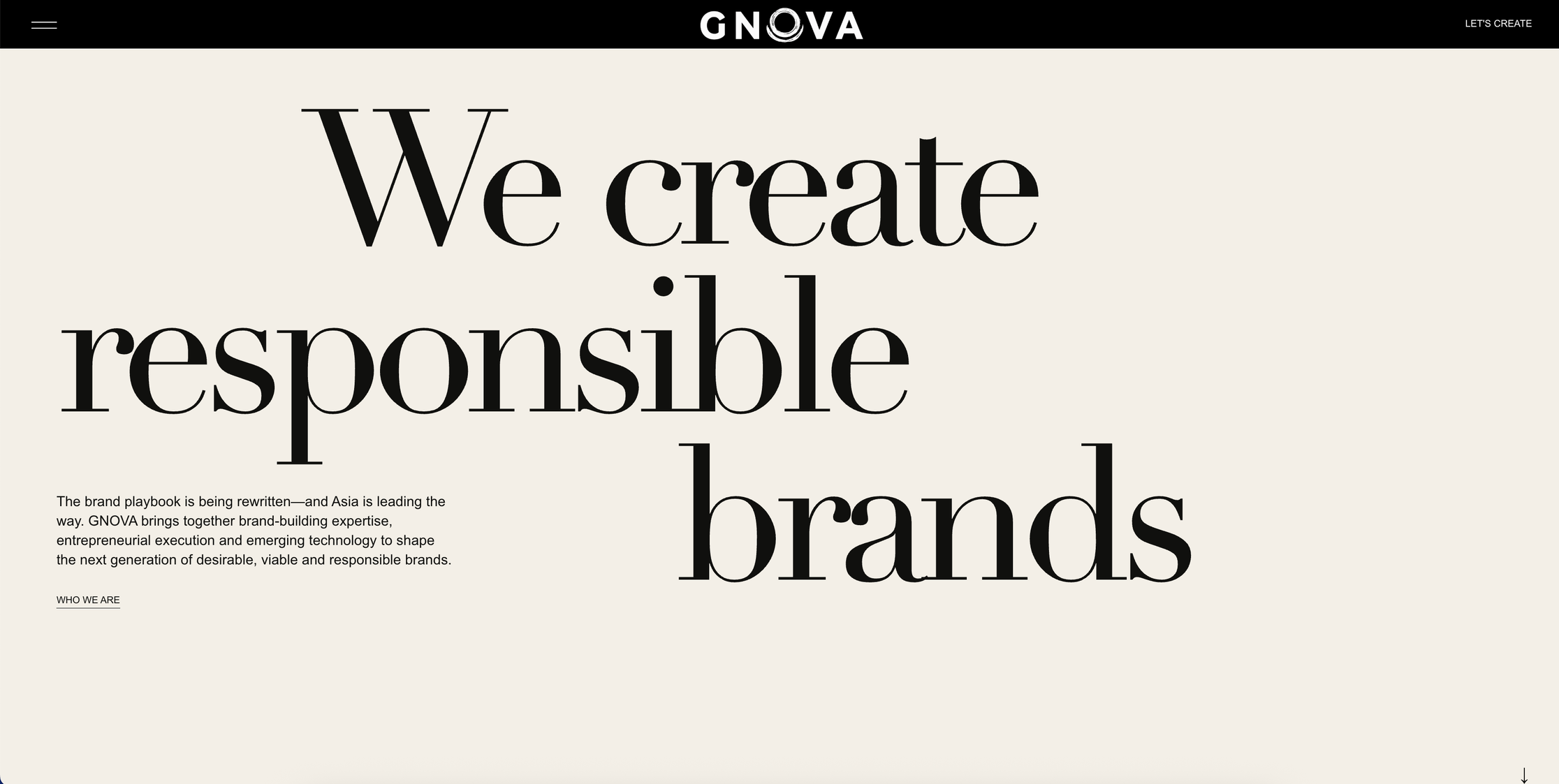
Two hours later, GNOVA's new website was live.
I did not write a line of code. I did not install a plug-in or add a custom skill. I did not begin with a template.
I simply described what I wanted in ordinary language, reviewed what appeared on the screen and continued directing the work: make this sharper; remove that arrow; the spacing feels wrong; align the image with the biography; this sentence says too much; that type is too small to read.
ChatGPT Work helped me define the architecture, develop the content, shape the visual system, build the pages, identify problems and eventually publish the site.
The experience felt less like operating software and more like directing a very fast, highly capable—but extremely literal—creative team.
The result was not simply a faster website.
It changed my understanding of what one experienced person can now build.
AI COMPRESSED A TEAM
INTO A CONVERSATION.
Building a website requires several elements to work together: a clear brand strategy and positioning, a well-structured customer journey, compelling content, effective visual design, reliable technology, and thorough testing to ensure a consistent experience across devices.
AI did not eliminate these jobs. It compressed their first stages into one continuous conversation.
I could move directly from an idea to a visible page, react to it and revise it immediately. There was no handover between strategy and copy, no waiting for a designer to interpret the brief, and no separate development queue for a small change.
That speed matters because many good ideas are lost in translation.
Working directly with AI shortened that distance. I could see the consequence of each decision almost immediately.
But “built in 2 hours” should not be confused with “created in one prompt.”
The site emerged through dozens of small decisions.
AI accelerated every iteration. It did not make those decisions for me.
THE CODE WAS NO LONGER
THE BOTTLENECK.
For a non-technical founder, code used to be the barrier between an idea and a working digital product.
That barrier is rapidly falling.
I did not need to understand the programming language behind the page. I needed to explain the outcome I wanted, recognise when the result was wrong and continue refining it until the experience matched the intention.
This is an important shift.
Technical literacy still matters, particularly for complex products, security, performance and scale. But the entry point has changed. A founder no longer needs to begin by asking, “Who can build this for me?” The first question can now be, “What exactly am I trying to build—and why should it exist?”
When execution becomes easier, clarity becomes more valuable.
AI can produce five headlines in seconds. It cannot know which one GNOVA should own.
It can generate an elegant page. It cannot decide whether that elegance expresses the brand or merely follows a fashionable design formula.
It can include every achievement. It cannot judge which ones strengthen the story and which ones make the story less focused.
The technical bottleneck is shrinking.
The new bottlenecks are judgment, taste and the ability to articulate a clear point of view.
HOW I BUILT IT INSIDE
CHATGPT WORK.
I did not begin by asking ChatGPT Work to “build me a website.”
I broke the process into three layers: structure, content and design.
1. START WITH STRUCTURE, NOT DESIGN
Before discussing colours or fonts, I needed to decide how the website should work.
What belongs on the homepage? Which ideas require their own pages? What should a visitor understand within the first few seconds? What action should they take next?
ChatGPT Work was remarkably effective at turning these questions into a workable site architecture. It helped organise the homepage, subpages, navigation and individual content sections. It could suggest what information belonged together, identify repetition and translate a broad business idea into a logical digital journey.
You do not need to begin with a wireframe or understand website terminology. You can describe the business, the audience and the desired outcome in ordinary language. AI can propose the structure—and build it.
But you still need to know what the website is for.
AI can organise the answer. The founder must define the question.
2. BUILD THE CONTENT SECTION BY SECTION
Once the structure was clear, I worked through the content one section at a time: what GNOVA does, what it believes, which projects to introduce and how my own experience should support the business without turning the site into a corporate biography.
The brand needed to feel forward-looking without becoming cold. It had to establish credibility without reading like a résumé. It needed to leave room for advisory work, brand incubation and my own writing while still presenting one coherent idea.
ChatGPT Work could generate options, sharpen sentences and identify repetition. It could help express the answer. It could not decide what GNOVA should stand for.
That direction came from two decades of branding experience: seeing which ideas survive contact with consumers, which presentations fail to become businesses, how global strategies change across Asian markets and why a desirable product must also be commercially viable.
The website took 2 hours to build. The ability to decide what it should say, show and leave out took much longer.
3. THE CLEARER YOUR TASTE, THE BETTER THE RESULT
The third layer was design.
“Make it look premium” is almost useless as an instruction.
Premium can mean quiet Japanese minimalism, a European luxury house, a technology platform or an editorial magazine. AI needs more than an adjective.
References help enormously. A website, screenshot, typeface, colour palette, layout or even one image can communicate what several paragraphs cannot. But do not simply say, “Make it like this.” Explain which qualities you want to borrow and which you do not.
The clearer the picture in your own mind, the more precise your prompts become—and the closer the result moves towards what you actually want.
My instructions became increasingly specific:
- Remove the arrows.
- Use black rather than a decorative accent colour.
- Align the image with the biography.
- There is too much empty space here.
- The source text is too small to read.
- Do not break this sentence across two lines.
Each instruction was simple. Together, they formed a design system.
AI did not give me taste. It gave me a faster way to apply it.
You do not need coding skills to start building. But you still need the skill of knowing what good looks like.
THEN CAME THE QUESTIONS
I HAD NOT ASKED.
By the end of the build, the website looked finished.
It was not.
A new set of questions appeared:
- How do I connect the domain and publish the site properly?
- Can visitors in mainland China access it?
- Why does the website not appear in Google search?
- Has Google indexed the individual pages?
- Are the page titles and descriptions written correctly for search?
- Does the site work consistently across desktop and mobile?

The version I had published could not be reliably accessed from mainland China. The site was live, but Google had not yet indexed it. A link that worked perfectly for me did not necessarily work for every visitor, market or network.
This was the moment I understood an important distinction:
Built is not live.
Live is not accessible.
Accessible is not discoverable.
ChatGPT Work had helped me create the website I asked for. But it had not proactively presented every question I did not yet know to ask.
That is a significant limitation.
AI is exceptionally responsive, but it is not always anticipatory. Unless you specifically request a launch-readiness review, it may not warn you about domain configuration, search indexing, analytics, accessibility, regional availability or performance.
The visible website may take 2 hours. The invisible infrastructure still demands attention.
THE MOST IMPORTANT PROMPT
CAME AT THE END.
After building the site, I realised that the final prompt should not be:
“Is the website finished?”
It should be:
“Act as a developer, search specialist, security reviewer and first-time visitor. Audit everything I may have forgotten before launch.”
That question changes the role of AI. Instead of asking it only to execute, you ask it to challenge the completeness of your thinking.
Even then, human verification remains necessary. You need to open the site from different devices, ask people in different markets to test it, search for it independently and check whether the experience matches what AI says should be happening.
AI can build at extraordinary speed.
Reality still performs the final quality check.
WHAT THE 2 HOURS
REALLY TAUGHT ME.
I began this experiment thinking I was building a website.
What I was really testing was a new way of working.
One person without coding knowledge could move from positioning to structure, content, design and a functioning digital product in a single day. No agency, external website builder or custom skill was required.
That is genuinely transformative. But it also reveals where human value is moving.
When production becomes easier, the advantage shifts towards people who can define the right problem, recognise quality, give precise direction and anticipate what has not yet been asked.
The website took 2 hours to build.
AI accelerated the execution. It did not replace the thinking.
This is not a technical tutorial. It is an operator's reflection on how AI is narrowing the distance between thinking and doing.
ONE FINAL NOTE
For first-time builders or simple showcase websites: Start with a regular ChatGPT conversation or Work mode. It is often enough to shape the structure, refine the content, generate the site and publish a live link. There is no need to add specialist Skills unless the project genuinely requires them.
For websites involving payments, memberships, customer accounts, sensitive data or complex integrations: Treat them as software products rather than simple websites. Codex and relevant Skills can support a more rigorous development workflow, but they do not replace proper architecture, security testing, compliance checks, deployment controls and ongoing maintenance.
The website took two hours.
The thinking took 20 years.
BONUS: FROM AI USER TO AI ORGANIZER
At ByteDance's 2026 mid-year all-hands meeting, CEO Rubo Liang, named to TIME's 2026 TIME100 AI list, was asked what would define exceptional talent in the AI era.
His answer was not stronger technical expertise or better execution. It was the ability to become an Organizer—someone who can discover value, define the right problem, coordinate resources and turn them into meaningful outcomes.
The reasoning is simple: AI is making execution as widely available and inexpensive as tap water. As execution becomes commoditised, human judgment becomes more valuable.
Google Cloud's AI Agent Trends 2026 report reaches a similar conclusion at the organisational level. As specialised AI agents undertake increasingly complex workflows, people will become their orchestrators—setting objectives, assembling capabilities, providing context and remaining accountable for the outcome.
An Organizer determines what is worth doing. An AI Orchestrator coordinates the people, agents, Skills and expertise required to deliver it.
Both point to the same conclusion:
AI may perform more of the work. Humans must still decide what work is worth doing—and lead it towards the right outcome.
AI can play more of the instruments.
But the human still leads the orchestra.