
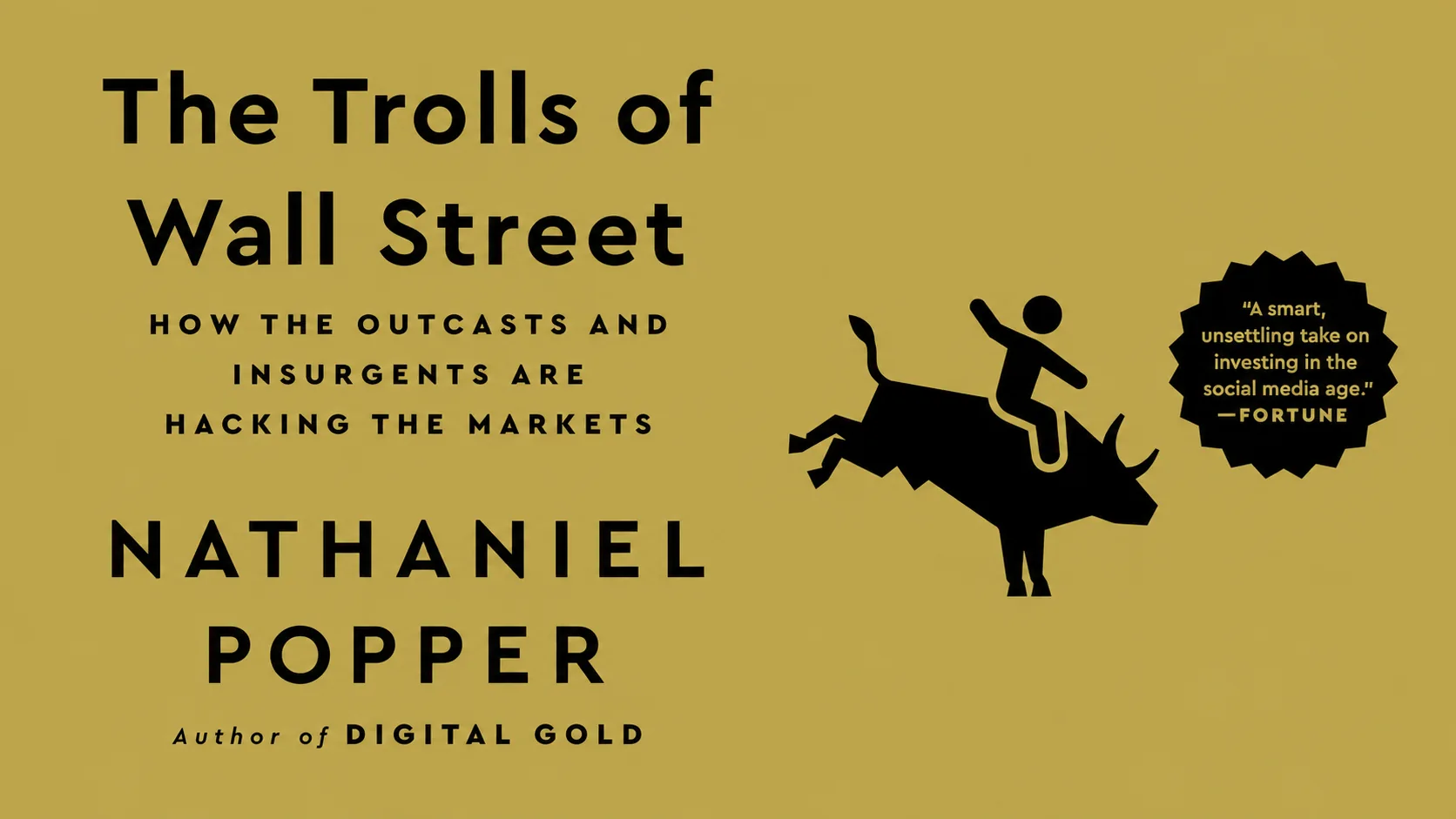
Recently, my son and I read The Trolls of Wall Street together.
He chose the book - which genuinely surprised me.
I suspect it was the phrase “hacking the markets” on the cover that caught his attention. After all, he is only twelve. To him, it probably sounded more like an adventure than a book about financial markets.
It turned out to be both.
As we read, we encountered a series of numbers that seemed almost impossible:
US$20.65 to US$483 in seventeen days.
Fewer than 10,000 accounts trading GameStop at the beginning of January 2021—nearly 900,000 by 27 January.
Average daily trading volume more than 1,400 per cent above the previous year’s level.
One man’s US$54,000 position growing to US$7.4 million at one point in the story.
At first glance, this appears to be a story about a group of unemployed young men using the internet to drive up the price of a struggling video-game retailer.
But that interpretation is both inaccurate and far too shallow.
Some had experienced unemployment. Others had jobs, education or money, yet still felt underused, isolated or unable to find a meaningful place in conventional society.
They did not begin with a master plan to move the market. They began by looking for income, stimulation, recognition, community—and somewhere their curiosity and conviction could matter.
Then something extraordinary happened.
They did not find a place in the established system, so they built a system in which their participation mattered—and eventually forced the established system to pay attention.
A Community of Outsiders
WallStreetBets emerged in the aftermath of the 2008 financial crisis, when trust in banks and markets had collapsed—particularly among a generation entering adulthood as jobs disappeared, homes were lost and major institutions received government support.
But the community was not created by one type of outsider. Three very different people reveal why it became so powerful.
Jaime Rogozinski was the architect.
By 2011, Jaime had a respectable job maintaining economic databases at the Inter-American Development Bank in Washington, DC. On paper, he was inside the system. In reality, he felt bored, isolated and increasingly disconnected from his own life.
Trading gave him intellectual stimulation, but the existing investment forums felt too cautious and conventional. They discussed finance as if it were purely rational. Jaime wanted somewhere people could also admit to risk, adrenaline, bad decisions and painful losses.
So, in 2012, he created WallStreetBets.
His most important contribution was not financial expertise. It was permission. He created a space where people who did not speak the language of traditional finance could participate without pretending to be professionals—and where failure could be shared rather than hidden.
Jordan Zazzara became the community builder.
A serious traffic accident at the age of twenty had left Jordan with lasting physical and psychological effects. Much of his life moved online. He discovered WallStreetBets while searching for a way to make his savings generate an income, but trading proved far harder than he expected.
What kept him there was not easy money. It was the challenge of learning, the honesty with which members discussed failure and the feeling that his abilities were useful.
Jordan gradually took on the invisible work that turns an audience into a community. He moderated conversations, built automated tools, helped move members onto Discord and created different spaces for trading, gaming and conversation. He also tried to prevent the community from being consumed by the political polarisation spreading across the internet.
Jaime gave WallStreetBets its original idea. Jordan helped give it structure, continuity and a daily social life.
Then there was the anonymous janitor—the clearest expression of what they had built.
He told Jordan that he worked for minimum wage, slept while the market was open and had never bought a stock. Yet the community brought him more joy than almost anything else in his life.
He was not there for investment returns. He was there because the community made him feel present, recognised and connected.
That confession reveals the deeper architecture of WallStreetBets. Its founder created the space. Its moderator made the space feel alive. Its members gave the space meaning.
Stocks were the subject. Belonging was the product.
WallStreetBets developed its own language, humour and status system. Members shared spectacular gains as well as humiliating losses. Memes made an intimidating financial world feel accessible and gave outsiders a culture of their own.
The community did not simply provide information.
It gave people identity, recognition and the possibility of participating in something larger than themselves.
When an Online Community Moved a Real Market
The defining moment came with GameStop.
By 2020, the American video-game retailer appeared to be in decline. Consumers were increasingly downloading games instead of visiting physical stores, and several hedge funds had placed large bets that the share price would fall further.
WallStreetBets members believed the pessimism had gone too far.
Keith Gill - known online as Roaring Kitty and DeepFuckingValue - had invested approximately US$54,000 in GameStop and had been publishing his analysis since 2019.
Gill had struggled through a long period of unemployment after graduating during the financial crisis. He began studying investments partly to earn additional income for his young family. By the time of the GameStop story, however, he was working in financial education and had developed a serious investment case.
He believed new gaming consoles could bring customers back and that investor Ryan Cohen might help move GameStop towards a digital future.
For months, other Reddit users mocked him.
Gill kept researching, explaining and holding.
His regular screenshots made his conviction visible. By the end of December 2020, his position was worth approximately US$3.7 million. At one point during the January surge, the book records that it had reached US$7.4 million.
His persistence became known as having “diamond hands.” The phrase turned an investment decision into a shared identity:
We believe. We will not be intimidated. We will not sell simply because the establishment tells us we are wrong.
More people began buying GameStop. As the price rose, some professional investors who had bet against the company had to buy shares back at higher prices, adding further momentum.
That is all a general reader needs to understand about the financial mechanism.
The more important story is how quickly collective belief became collective action.
On 11 January 2021, GameStop reached an intraday high of US$20.65.
Seventeen days later, it reached US$483.
The number of unique accounts trading GameStop rose from fewer than 10,000 at the beginning of the month to nearly 900,000 by 27 January.
Between 13 and 29 January, an average of approximately 100 million shares traded every day - more than 1,400 per cent above the 2020 average.
A reinforcing loop had formed:
Research created conviction.
Conviction created participation.
Participation moved the price.
The rising price attracted attention and more participants.
The US Securities and Exchange Commission later concluded that professional investors closing their short positions contributed to some of the increase, but represented only a small proportion of overall buying.
The price was sustained primarily by positive investor sentiment.
WallStreetBets did not merely discover an unusual financial opportunity.
It helped create a belief system powerful enough to move real capital.
The Impact Went Beyond GameStop
Some institutions that had bet against GameStop suffered substantial losses. Melvin Capital closed its position and received a combined US$2.75 billion capital injection from Citadel and Point72.
The volatility spread to other meme stocks. Several brokerages temporarily restricted purchases as they struggled to meet financial requirements, provoking widespread anger among retail investors.
The story moved from Reddit to regulators, the White House and the United States Congress.
In February 2021, Keith Gill appeared before the House Committee on Financial Services alongside the leaders of Robinhood, Reddit, Citadel and Melvin Capital.
A community that began with around 50 people had become capable of moving billions of dollars and compelling some of finance’s most powerful institutions to respond publicly.
The people dismissed as “dumb money” had forced Wall Street to take digitally connected individuals seriously.
What They Were Really Searching For
This is where the book becomes more than a financial story.
Many WallStreetBets members were not only searching for profit. They were searching for their place in society.
The traditional path to success appeared increasingly uncertain:
- Education did not guarantee a meaningful job.
- Hard work did not always create financial security.
- The financial system appeared to favour people who already controlled capital and access.
- The internet, however, allowed ordinary people to organise and act together.
Trading gradually became more than a financial activity. It became a form of social participation.
Members were not only buying shares. They were buying the possibility that their presence could affect the outcome.
But the book does not romanticise them as heroes.
WallStreetBets could be aggressive, exclusionary and deeply speculative. Conviction sometimes became group pressure. Some participants made fortunes, while others lost their savings after buying near the top.
The community challenged established financial power, but it did not eliminate inequality or automatically create a fairer system.
Breaking an old system does not guarantee that the new one will be better.
What This Reveals About the Next Generation
Reading this story beside my twelve-year-old made me think differently about the world his generation is entering.
Young people have more choices than any generation before them - but fewer stable answers about what life is for.
Education may no longer guarantee security. Careers may be disrupted by technology. Social media offers connection while intensifying comparison. Artificial intelligence is forcing young people to question not only what they should learn, but whether it will still matter.
Previous generations inherited a relatively recognisable script:
Study hard. Find a stable job. Build a career. Buy a home. Raise a family. Progress through the system.
That script did not make everyone happy. But it provided structure.
The next generation is expected to design its own identity, choose its own values, build its own community and define its own version of success—while performing that identity publicly online.
They have more freedom.
But fewer anchors.
Perhaps young people are not lacking purpose.
Perhaps they are losing confidence in the institutions that once defined it for them.
Jaime had a job but could not find meaning in it. Jordan had money but struggled to find a useful place in the physical world. Gill had intelligence and competitive drive but spent years searching for somewhere to apply them.
They were not simply unemployed.
They were underused, disconnected and searching for somewhere their conviction could matter.
When the established system did not provide that place, they built their own.
What This Means for Brands
Brands have always sold more than products.
Luxury brands sell status. Beauty brands sell transformation. Sports brands sell self-belief. Technology brands sell progress.
But the traditional relationship remains largely one-directional:
The brand creates. The brand communicates. The consumer watches and purchases.
WallStreetBets demonstrates a different model.
The community did not simply receive a story. Its members were given roles inside it.
Jaime created the space. Jordan helped build its culture. Gill provided research and visible conviction. Members created the memes, language and symbols. Hundreds of thousands of participants turned belief into observable market impact.
The most powerful message was not:
Listen to our story.
It was:
This story is happening because you are here.
The Foundations of the Next Great Brands
I. A Role, Not Just a Story
Storytelling attracts attention. A role creates participation.
The next generation will not only ask what a brand stands for. They will ask what becomes possible because they participate.
II. Visible Impact
GameStop’s share price provided immediate evidence that collective participation was producing an effect.
Most brand communities offer no equivalent proof. People attend, post and contribute—but rarely see what changed because they were there.
Future brands must make contribution visible: What was created? Who was helped? What culture was preserved? What became possible because the community participated?
III. Community-Created Culture
“Diamond hands” became powerful because it belonged to the community—not to a corporate copywriter.
The strongest brands will provide cultural raw material while allowing people to interpret, adapt and build upon it.
IV. Belonging Without Conformity
Belonging should not require people to surrender independent judgment.
A healthy community must allow disagreement without treating dissent as disloyalty.
V. Participation With Responsibility
Lowering barriers can be empowering. But easier access does not automatically create better judgment or greater protection.
Brands must ask whether participation leaves people more capable and in control—or simply makes disengagement more difficult.
Loneliness, uncertainty and the search for purpose are not consumer vulnerabilities to exploit.
A brand can create connection, but it should not claim to cure loneliness. It can create opportunities to contribute, but it should not convert every search for meaning into another transaction.
From Attention to Participation
The defining brand competition of the last decade was for attention.
The defining competition of the next decade may be for meaningful participation.
But participation creates responsibility.
WallStreetBets shows the power of people who believe their actions matter. The GameStop aftermath shows the risks when collective conviction, speculation and platform incentives become difficult to separate.
The responsibility of a brand is not to give young people a purpose.
It is to create honest conditions in which agency, belonging and contribution can grow.
Because the next great brand may not be the one that persuades the most people to buy.
It may be the one that gives people the most meaningful role in building something together.
The old brand model said: Believe in us.
The next one will say: Build with us.